Nestled in the heart of urban Kolkata, Sarada Vidya Bhawan is a government-funded girls’ school serving students in grades 5–12. The school provides free education for girls in Classes 5–10, along with computer training, transportation, and vocational training for women by opening doors to opportunity every single day.
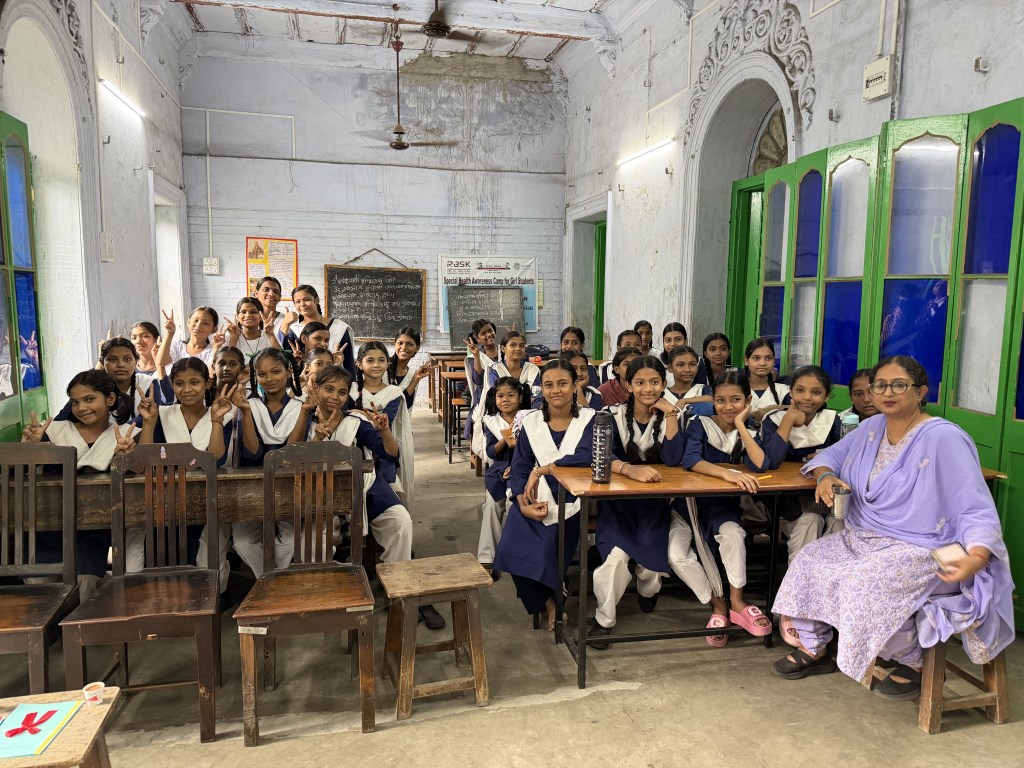
What took my breath away wasn’t just the mission of the school, but the building itself. Housed in a magnificent palace built for the son-in-law of Lokmata Rani Rashmoni, the campus is filled with soaring ceilings, intricate architectural details, stained and cut glass, bronze statues, and open, airy spaces that make learning feel extraordinary.
Rani Rashmoni (1793–1861) was a visionary businesswoman, philanthropist, and champion of social justice who broke barriers for those without a voice. It feels especially fitting that today, young girls are being educated within walls connected to a woman who spent her life challenging the very obstacles many of them are still overcoming. I couldn’t help but hope that every student who walks these halls feels like the princesses they truly are.
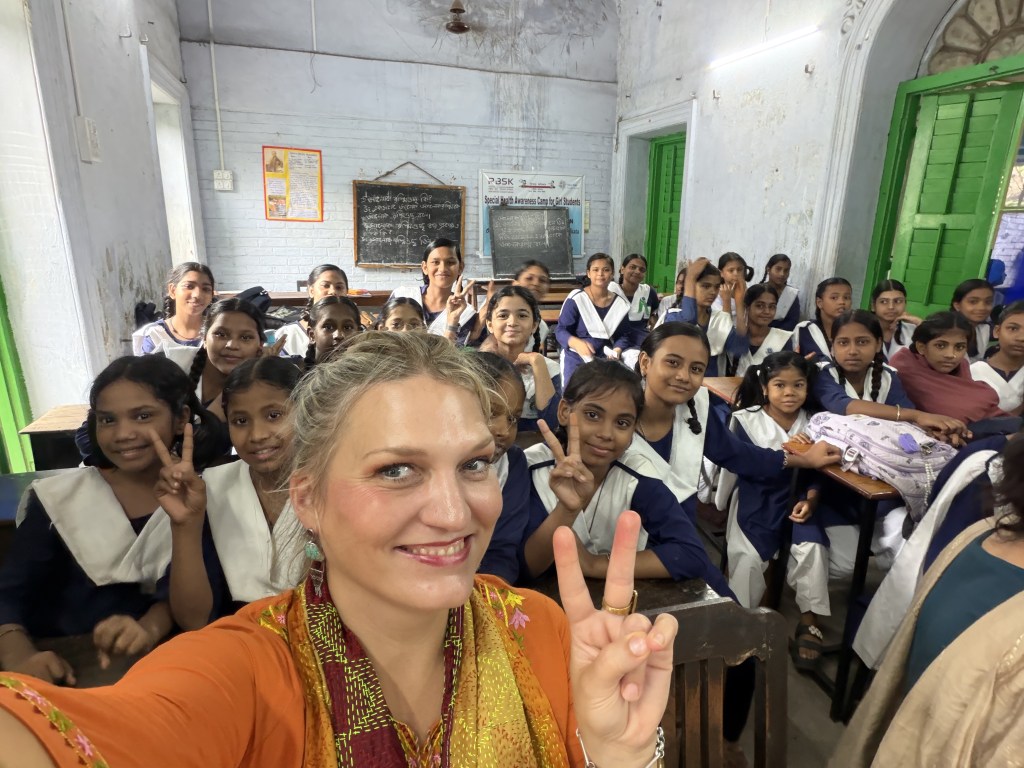
Although we arrived on a Saturday, the staff and students welcomed us with incredible enthusiasm. Their warmth, pride, and excitement to share their school made us feel like honored guests from the very first moment.
We had the opportunity to share a presentation about our schools in the United States and what teaching and learning look like in American classrooms. The students were curious, engaged, and eager to exchange ideas, reminding me that education has the power to connect people across cultures.
One of the first things I noticed while walking through the school was the abundance of student artwork. It was immediately clear that the arts are a foundational part of the culture at Sarada Vidya Bhawan. While art is not a scheduled subject, my host teacher, Sudeshna Dutta, intentionally weaves creativity into every lesson. Whether students are creating mind maps, using visual storytelling to communicate ideas, or expressing their own cultural experiences through art, she ensures that creativity is a pathway to deeper learning, confidence, and connection.
One of my favorite examples of this is how Sudeshna empowered her students to beautify their own school. The intricate designs decorating the walls and columns weren’t created by professional artists. They were painted by her students, inspired by traditional mehndi patterns (which many Americans will recognize as the beautiful designs used in henna body art). Their artwork transforms the historic building into a space that reflects both the school’s rich heritage and the creativity of the girls who learn there every day.
Sudeshna is one of the most inspiring educators I have ever met. She leads with intelligence, compassion, and quiet strength, empowering her students to believe in themselves while nurturing both academic excellence and confidence. Watching her teach was a masterclass in what education should be.
As part of my Fulbright Teachers for Global Classrooms experience, I came to India with the question: How do Indian educators integrate cultural traditions, including the arts, to support students’ mental health and holistic development, and how can these practices inform my work as a teacher leader?
At Sarada Vidya Bhawan, I found part of the answer. Culture and creativity weren’t treated as “extras”—they were woven into the fabric of everyday learning. Students weren’t simply memorizing content; they were expressing themselves, honoring their heritage, collaborating with one another, and taking pride in their environment. Those experiences cultivate belonging, confidence, and well-being just as much as they build academic skills.
As I return home, I hope to continue creating spaces where students see themselves reflected in their learning, where art is not just something we make but a way we process our experiences, celebrate our identities, and build community. Sudeshna reminded me that nurturing the whole child doesn’t always require more time or resources. What is does require is intention.
Sarada Vidya Bhawan is so much more than a school. It is a place where history, opportunity, creativity, and hope come together to remind every girl that her future is worth investing in.
Thank you, Sudeshna Di Di, and everyone at Sarada Vidya Bhawan, for opening your doors and your hearts to us. This experience, and the lessons I learned from you, will stay with me long after I return home.


Leave a Reply